

The creative domain of storytelling is being reshaped by AI, and this article breaks down one of our student’s projects that shows exactly how.
If you’ve ever tried to build a narrative film using today’s generative tools, you’ve likely encountered the same problem Jeff Hipolito set out to solve: once a story grows beyond a few pages, everything starts to break. Characters lose consistency, arcs drift, and context windows collapse. The process becomes fragmented across tools that don’t speak to each other.
CineMachine is Jeff’s response to that fragmentation.
Developed as a modular AI-powered storytelling pipeline, CineMachine is designed to support the entire creative process, from early story development through scene and shot design, without sacrificing narrative coherence along the way.

As Jeff explains:
Even with all the AI tools available these days, it’s still daunting to create a narrative film, having to jump from one tool to another. I built CineMachine to make the process from story development to production smoother and more accessible.
What makes CineMachine notable isn’t just what it generates, but how deliberately it structures the creative process.
The Core Problem CineMachine Is Solving
Most AI-assisted storytelling workflows rely on long, unstructured documents. Writers dump world-building, character notes, arcs, and scene ideas into a single file and hope the AI can keep up.
It works… Until it doesn’t.
As stories grow, context limits are exceeded. The AI forgets motivations, relationships, and established logic. The result is writing that feels increasingly disconnected from the original vision.
CineMachine is built specifically to counter that failure mode.

Rather than relying on one massive document, it treats story elements as modular, structured components: small enough to remain legible to an LLM, but rich enough to support long-form storytelling.
The goal is simple: AI should write with you, not over you.
CineMachine in Plain Terms
CineMachine is a suite of interconnected tools that cover key stages of narrative development:
Character building
Scene and shot design
Story and arc development
First-frame generation (in development)
Automated video rendering (planned once frames are locked)
The workflow begins with a logline and world notes. The system asks for genre, sub-genre, and runtime, then proposes archetypes aligned with those inputs. From there, creators can define, or allow the AI to suggest, physical descriptions, goals, backstories, and relationships.
The more structure provided, the more nuanced the output becomes.
The result isn’t placeholder characters, but story-ready personas that can evolve across scenes and episodes without losing internal logic.
A Structured Walkthrough of the CineMachine Workflow
Step One: Build a Character Roster
The foundation of CineMachine is a tightly structured cast list.
Each character begins with a small, focused set of attributes — name, role, desire, and narrative context — kept deliberately concise so the AI remains grounded.
Rather than expanding into prose-heavy descriptions, CineMachine relies on structure. Notes are transformed into standardized character blocks using an in-app chat module that acts as a collaborator rather than a replacement.
This approach keeps character data readable, reusable, and resilient as the story scales.

Step Two: Map Relationships
Relationships are treated as first-class story components.
CineMachine supports defining how characters connect (mentor, rival, sibling, ally) along with brief notes on shared history and current tension. These relationships form the backbone of narrative conflict and are designed to remain visible rather than buried in paragraphs of text.
Jeff also references relationship graphs as a way to visualize dynamics and maintain clarity across complex casts.

Step Three: Assign Arcs and Motivations
Every character in CineMachine is anchored by an arc.
Rather than open-ended descriptions, arcs are framed through a clear structure: what the character wants, what stands in the way, and how they change. Prompt seeds help shape these arcs consistently across a project.
CineMachine’s Story Builder currently supports three-act structures, with additional narrative frameworks planned for future development.
Step Four: Compress for Context
Context management is central to CineMachine’s design.
Instead of feeding everything into a single prompt, story elements are summarized into smaller, purpose-built blocks. Characters, arcs, and subplots are separated and trimmed so only what matters to the current scene is included.
This allows the AI to remain effective even as the narrative grows in scope.
Step Five: Export for Scene and Shot Generation
Once the story logic is stable, CineMachine translates narrative data into formats suitable for visual development.
Character and scene notes are organized into structured tables that can be used to generate first frames and camera-ready prompts. Jeff contrasts this with earlier workflows that required jumping manually into tools like ComfyUI, Midjourney, or Runway for visual prototyping.
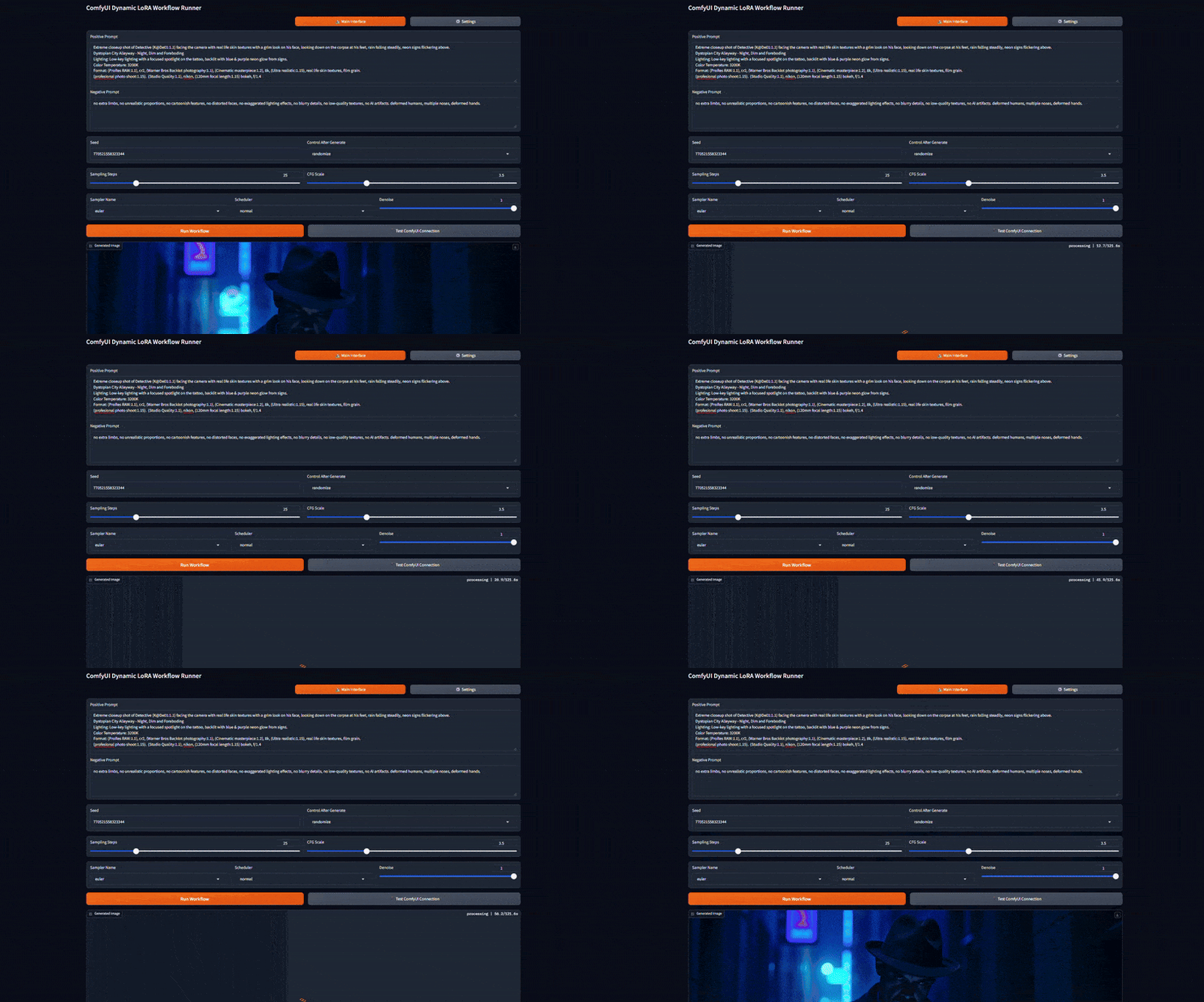
Looking ahead, CineMachine is being designed to automate shot generation once first frames are approved. Initial tests using the LTX video model produced over 60 shots overnight on a single RTX 4090, demonstrating the system’s potential for scale.
Case Study: Skinwalker
CineMachine is actively being tested on Skinwalker, an eight-episode sci-fi detective mini-series.

Each stage of the system feeds directly into Jeff’s production workflow, from character rosters and arcs to structured scene breakdowns and prototype visuals. Long-form storytelling serves as the proving ground, where CineMachine’s approach to structure and context is stress-tested in real conditions.

Jeff describes the process as “building the plane while flying it,” highlighting both the ambition and practicality of developing a system alongside an active creative project.

Why CineMachine Matters
Most AI storytelling tools excel at short-form output. CineMachine is designed for what comes after.
By emphasizing structure, modularity, and context control, it points toward a future where AI functions as a coherent narrative partner rather than a novelty generator. Characters retain continuity, arcs remain legible, and visual development connects directly to story logic.

The shift is subtle but important:
AI becomes part of a production system, not a creative shortcut.
What We Learn From CineMachine
CineMachine demonstrates that scalable storytelling with AI depends less on prompting tricks and more on system design.
It shows what happens when:
Relationships and arcs are explicitly defined
Characters are treated as structured data, not prose
Context is managed deliberately rather than reactively
Story and visualization are designed to feed into one another

By breaking complex narratives into smaller, resilient components, CineMachine keeps creative intent intact even as projects grow in scope.
Structure, Story, and Systems
CineMachine offers a glimpse into how future creative pipelines may be built, where writing, visualization, and production are part of a single, continuous workflow.
AI isn’t the headline here. It’s the engine that accelerates iteration while structure preserves meaning.
That same mindset underpins how we teach at Lighthouse AI Academy: designing workflows that scale, systems that hold together, and creative processes that support long-form thinking.
And that’s what CineMachine ultimately illustrates:
AI isn’t here to replace storytellers; it’s here to support better systems for telling stories well.
Watch Jeff’s Webinar Replay for a full demo + a behind-the-scenes of his workflow.
Learn with Lighthouse Academy: Using AI to Enhance, Not Replace
If you want to explore how structured workflows like this translate into real creative pipelines, our upcoming courses, including Advanced ComfyUI, Basic ComfyUI, AI for Creative Leaders, and our Architecture Studio, are open for applications.
You can also book a call with our team to discuss which path fits your goals.
At our academy, we’re here to help you design workflows, not just prompts; systems, not just shots.
View our courses now and begin your journey to creating whatever your heart desires.
Any questions or comments about the article?
Message us and let us know your thoughts!